
01 | THE INVISIBLE GIFT OF VACATION
What happens in your child’s brain while they sleep, and while they read, matters as much for their development as any hour of class.
Neuroscience confirms it. It’s time to act.
This week, while Howard Academy Group students enjoy their vacation, something quiet but extraordinary is happening in their brains. It doesn’t appear on any school calendar. It isn’t measured on any test. But neuroscience has documented it for decades, with a clarity that leaves no room for debate:
“They’re consolidating what they learned. And if they’re also reading for fun, they’re building the mental architecture that will hold up all their future learning.”
Sleep isn’t a pause in learning. Reading isn’t a minor hobby. They are the two great drivers of cognitive development we most underestimate as a society, and the ones with the biggest impact on our children’s academic and life paths.
What the Brain Does While Your Child Sleeps
02 | THE NEUROSCIENCE OF REST
During deep sleep, the brain doesn’t rest. It works with an efficiency no artificial tool can match: it reviews what was learned during the day, discards redundant information and consolidates what matters, moving it from short-term memory into long-term memory. Neuroscientists call this sleep-dependent memory consolidation. In children, this process is especially powerful and especially sensitive to their environment.
A University of Maryland study published in The Lancet Child & Adolescent Health (2022), with data from more than 8,300 children ages 9 and 10, found that those who slept less than nine hours a night had less gray matter in the brain areas responsible for attention, memory and self-control. Most important: those differences were still there two years later. This isn’t about performance that goes up and down. These are structural changes confirmed with MRI scans.
Scientific evidence: brain structure and sleep
A review of 67 studies of young people ages 5 to 17, published in Sleep Medicine Reviews (2015), found that in 90% of them, more screen time was linked to later bedtimes and poorer sleep. The device that “entertains” in bed is literally getting in the way of how the brain learns.
How Much Sleep Does Your Child Need?
These are the recommended sleep ranges published by the American Academy of Pediatrics (AAP) and the CDC. Individual needs can vary, but consistently getting enough sleep supports healthy development, attention and learning.
Stage
Hours of sleep
Note
Toddler (18–36 months)
11–14 h
Includes naps
Preschool (ages 3–5)
10–13 h
Includes naps
Elementary (ages 6–12)
9–12 h
Nighttime sleep
Teens (ages 13–17)
8–10 h
Nighttime sleep
Only about half of children ages 6 to 17 in the United States get these hours. Panama doesn’t have its own consolidated data, but the trend is no more encouraging.
The Problem Sleeping Next to Your Child
03 | SCREENS, SLEEP AND THE READING BRAIN
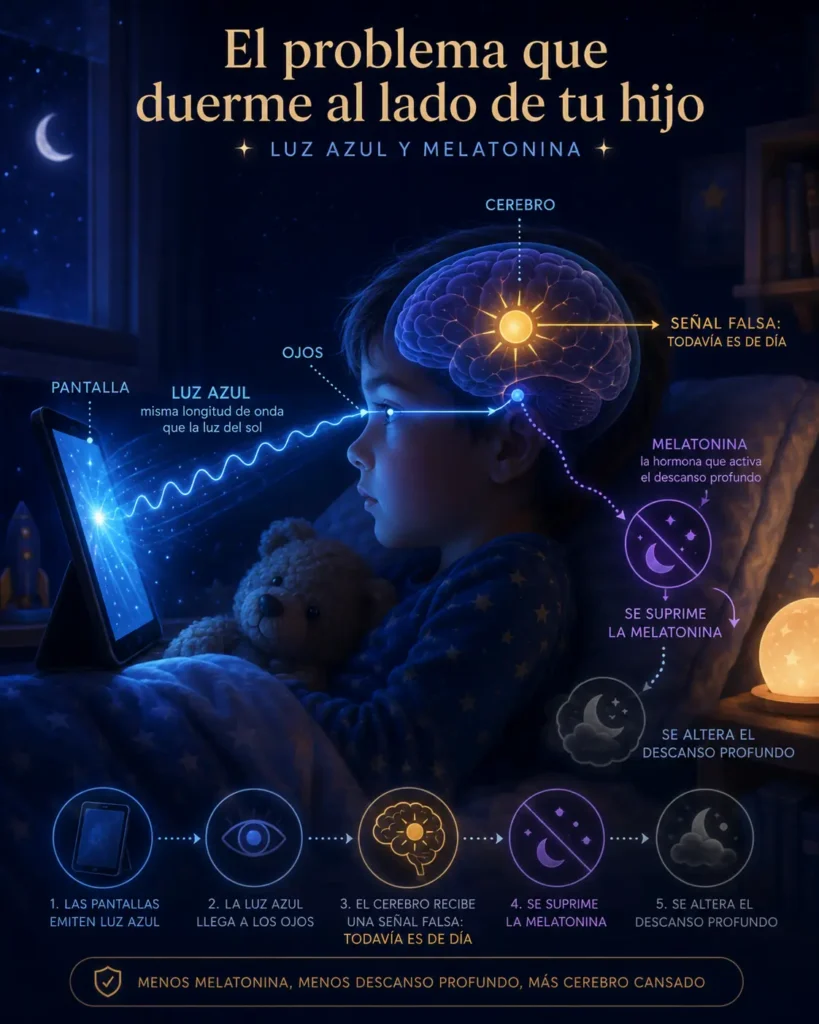
Screens give off blue light, the same wavelength the sun uses to tell the brain it’s daytime. When that light reaches a child’s eyes in the hours before bed, it suppresses melatonin, the hormone that triggers deep rest.
The brain gets a false signal: it’s still daytime. Melatonin and screens, by the numbers: a study of children ages 3 to 5, available through NIH/PMC, found that exposure to bright light for one hour before bed lowered melatonin levels by 69% to 99%. Children are biologically more vulnerable: their pupils are larger and the lenses of their eyes are clearer, so they take in more light from the same exposure.
“Through a child’s eyes, exposure to a bright screen before bed is the perfect storm for disrupted sleep and circadian rhythms.”
Dr. Monique LeBourgeois, University of Colorado Boulder
If sleep consolidates what the brain already has, reading builds the structure that holds it all up. The brain evidence on what happens in a child who reads regularly is as strong as the evidence on sleep.
What reading does that nothing else does the same way. Research from the University of Cambridge and the Max Planck Institute shows that sustained reading activates areas tied to language, empathy, episodic memory and planning at the same time. Reading requires the reader to actively build a mental picture of the world in the text. In neuroscience terms, that’s high-quality cognitive work.
Vocabulary is one of the strongest predictors of long-term academic performance, and its most powerful source isn’t everyday conversation or direct instruction. It’s wide, steady reading from an early age.
Longitudinal study, UCL Institute of Education (London). A study that followed about 17,000 people born in 1970 found that children who read for pleasure at age 10 and at 16 made more progress in vocabulary, spelling and math between ages 10 and 16, regardless of their family’s social or educational background. Reading for pleasure had a bigger effect on progress than the parents’ level of education.
Reading aloud with your child, at any age, is one of the most powerful acts of emotional connection a family has. It isn’t just vocabulary. It’s active listening, sustained attention and comfort with not knowing what happens next. These are skills no app can teach.
Ten Things You Can Do This Week
04 | RECOMMENDATIONS BACKED BY SCIENCE
Vacation is a real opportunity. Without the rhythm of the school week, you can reset habits the school term doesn’t leave room for.
Set times to sleep and wake up, every day
Children’s brains run on precise biological clocks. Going to bed and getting up at the same time, even on vacation, keeps the body clock in rhythm.
Screens off 60 minutes before bed
This isn’t a vague tip. The way blue light suppresses melatonin is documented, measurable and completely preventable.
A dark, cool, quiet room with no phone
A room temperature of 18 to 20 °C (64 to 68 °F) helps deep sleep begin. Total darkness boosts melatonin. The phone doesn’t sleep in your child’s room. No exceptions.
A wind-down routine
Bath, reading, calm conversation. Children with consistent bedtime routines fall asleep faster, wake up less and start the next day more emotionally balanced.
Planned naps for toddlers and preschoolers
For many toddlers and preschoolers, naps remain an important part of meeting their total daily sleep needs. Research has also found that daytime sleep can support memory consolidation in young children.
Daily reading: at least 20 minutes
Make daily reading a consistent habit. Even 15 to 20 minutes a day adds up to many hours of reading over a year, creating regular opportunities to strengthen vocabulary, comprehension, fluency and a lasting relationship with books.
Read aloud, at any age
Children can listen to and understand texts far more complex than the ones they can read on their own. Reading together grows vocabulary, models the rhythm of written language and sparks real conversation.
Let your child choose what to read
Personal interest multiplies motivation. What they read matters less than the habit of reading. Variety comes on its own once reading is a pleasure and not an obligation.
Printed books in plain sight in their room
A study of 160,000 adults in 31 countries (Social Science Research, 2019) found that growing up with about 80 printed books at home was linked to significantly stronger reading and math skills in adulthood, regardless of the parents’ education level.
Read too, and let them see you
Children don’t do what we say. They do what they see. If they see you read, they’ll read. Parents’ example is the strongest predictor of a reading habit in childhood. You don’t need to explain it. You need to show it.
How HAG Builds Rest and Reading into the Day
05 | OUR EDUCATIONAL MODEL
At Howard Kids Academy, schedules are designed around children’s natural cycles of energy and rest. Nap time isn’t a scheduling concession. It’s part of the curriculum. The read-aloud program is a built-in part of every school day, not an extra when there’s time left over. At Howard Academy, teachers are trained to recognize when a student comes to class short on sleep and to understand how that affects their attention that day. We don’t penalize it. We address it.
HAG’s Commitments to Rest and Reading
◆ HKA schedules built around rest cycles for each stage of development.
◆ A structured read-aloud and independent reading program at every level.
◆ Teacher training in emotional regulation and in spotting signs of mental fatigue.
◆ An active classroom library: every child has a book of their own, chosen by them and always within reach.
◆ Ongoing communication with families about sleep and reading habits as part of our whole-child support.
◆ Classrooms designed for deep focus and for building literacy.
A Personal Message
06 | FROM THE AUTHOR
In twenty years of educating children and teens in Panamá Pacífico, I’ve seen the same pattern again and again: students who sleep well and read regularly don’t just do better in class. They show up differently. They’re more present. They ask more questions. They get frustrated less. They build a kind of cognitive resilience you can’t get any other way. It isn’t talent. It isn’t attitude. It’s biology and habit, and both are fully within reach at home, this week, through small and consistent choices. This vacation week is a gift. It isn’t for filling with activities, tutoring and screens until midnight. It’s for real rest. For reading for fun. So the brain can file away what it learned, process it and come back to the next term ready to learn.
“Rest doesn’t interrupt learning. Reading doesn’t interrupt learning. Without them, learning simply isn’t possible.”
Tania Fleming, Howard Academy Group